Incorporating renewable energy sources onto marine vessels could be an effective way to both reduce carbon emissions, as well as being cost efficient by minimising the cost of fuel. One way to achieve this is by installing solar panels on these ships in order to generate solar energy to run these vessels.
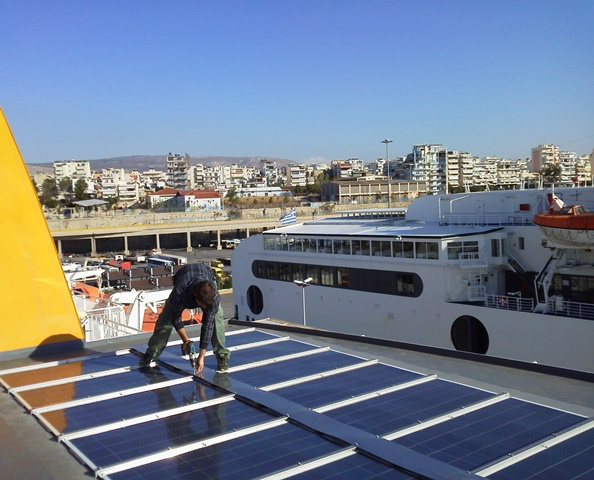
Marine solar power systems can be installed on large vessels such as car carriers, cruise ships and large ferries. They can also be installed on smaller vessels such as river boats. Figure 1 below shows how a Marine Solar Power Array being installed.
Stackhouse and Whitlock, 2008 state that the globe is divided in six distinct zones, allowing energy production of the solar installation systems to be calculated in relation to solar radiation density. For one square meter of the solar panels the peak output power equates to 130 W (Kagaraki, 2001).
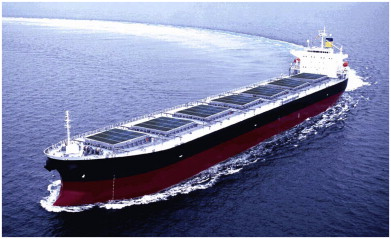
Also states that these solar panels should be installed above the deck of the ship and at a zero angle (see Figure 2). This is recommended because in this position the solar panels will be most effective at absorbing solar radiation.
Alexandro Glykas highlights that data shows that zones that are nearest to the equator receive a larger level of solar radiation density. Therefore, marine vessels that operate in those zones have much greater solar energy production.
Future of Solar Sails
Although solar sailing is argued to be a sustainable and renewable energy supply, there are many criticisms. One downside is that the cost to install this technology is very expensive and it often takes years to generate enough energy to even make a profit. An installation of a 150 kW solar panel array would cost from $420,000 to $450,000 (USD).
Solar sailing is estimated to reduce in economic cost after some time when the technology becomes more common. However, there still needs to be significant progress in reducing the size of these structures and making them more efficient. This includes making them hardwearing for when they are put through harsh weather conditions.
EnergySails
This year will see the combination of both solar and wind energy technology being used on a marine vessel called EnergySails. Eco Marine Power (EMP) is the Japanese company that has developed this renewable energy system that generates power from both the sun and wind.
The EnergySails will also be effective when the ship is on the dock and the NewAtlas report has commented that the sails will be made of a sturdy material such as steel, which allows it to be durable in any weather condition.
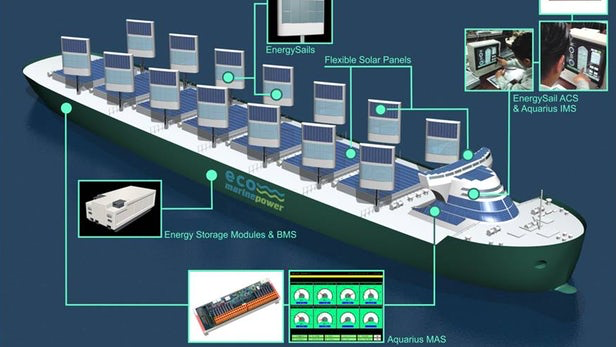
Source: Eco Marine Power